A lot of shopping journeys now start with a conversation with AI. Where can I buy running shoes? What’s a good toy store for a six-year-old? ChatGPT and co. answer in a tidy paragraph. Google prints its own AI summary above the usual links, whether you asked for one or not. It feels neutral, like a clerk pointing you to the right aisle.
I think one of the reasons it feels natural is because we imagine this super smart AI scanning all websites, directories and genuinely coming up with the best recommendation, out of all available information.
But this is not the case. LLMs have a large amount of intrinsic bias.
To answer just what type and how much bias, I ran a large-scale study on behalf of Lightspeed Commerce using the AI platforms Americans and Canadians use to shop, and one pattern kept surfacing: these AI assistants push you toward big national chains and skip right past the small and local stores.
The study is split into three parts. First, I asked the AI to name a store with web search switched off, using questions that never mention size or the word “local.” That’s 200k answers, and it shows what the model believes about where people should shop. The reason for this is to force the model to use its own knowledge to answer.
Then I asked the same questions again with live web search on, the way you actually use these platforms, across ChatGPT, Google AI Mode, and the Google AI Overview box. That added 260k answers and 2.5 million links, and it shows what you actually get.
Finally, I conducted a controlled test to see if modifying the prompts with phrases such as “near me”, “local” or “independent” has a material effect on the outcome.
Let’s dive in.
TL;DR
- I analyzed around half a million AI responses for the US and Canada, across ChatGPT, Google AI Mode and Google AI Overviews.
- From its training data, the AI names a national chain about two-thirds of the time and a small or local shop only one in ten. Put a big chain and a smaller store side by side with no labels, and it picks the big one 90 to 94 percent of the time.
- Turning on live web search helps, but only by about a third. When the AI names a store, it’s still a national chain about half the time and a local shop about a quarter.
- Google’s AI Overview is the worst, and the one most people see. Two out of three of its shopping answers name no small or local store at all.
- The closer you get to buying, the bigger the store. Name a specific product and a small shop’s odds of being the top pick fall from about one in three to one in ten.
- The local shops do show up in the AI’s source links, just not in what it actually recommends. The deeper you go, from the links it cites, to the stores it names, to the one it names first, the more the small shops drop away.
- A short list of giants does most of the work. About ten chains account for 40 to 44 percent of every recommendation, and no small or local store makes the top twelve. Where you live tilts it too: heaviest toward big chains in Los Angeles, lightest in Montreal.
- There is a simple fix, and it is a single modifier word. Ask for “independent” stores and the big chains’ share of the AI’s picks falls sharply, to as low as one in ten on Google’s platforms. Asking for “local” or “near me” barely helps, because the AI treats a nearby chain as local. The large retailer bias carries over if you just ask for stores that are located geographically close to you.
Part 1: What the AI thinks on its own
Before a single web result loads, the AI model already has an opinion. This is important because I believe this intrinsic bias plays a role in recommendations later, additive to the web results.
To examine this, I turned web search off and asked ChatGPT and Google’s Gemini to name a store, 200,000 times, across ten everyday shopping categories and four cities. None of the questions mention size, popularity, or being local. Whatever the AI does here is its own instinct, not something I baited.
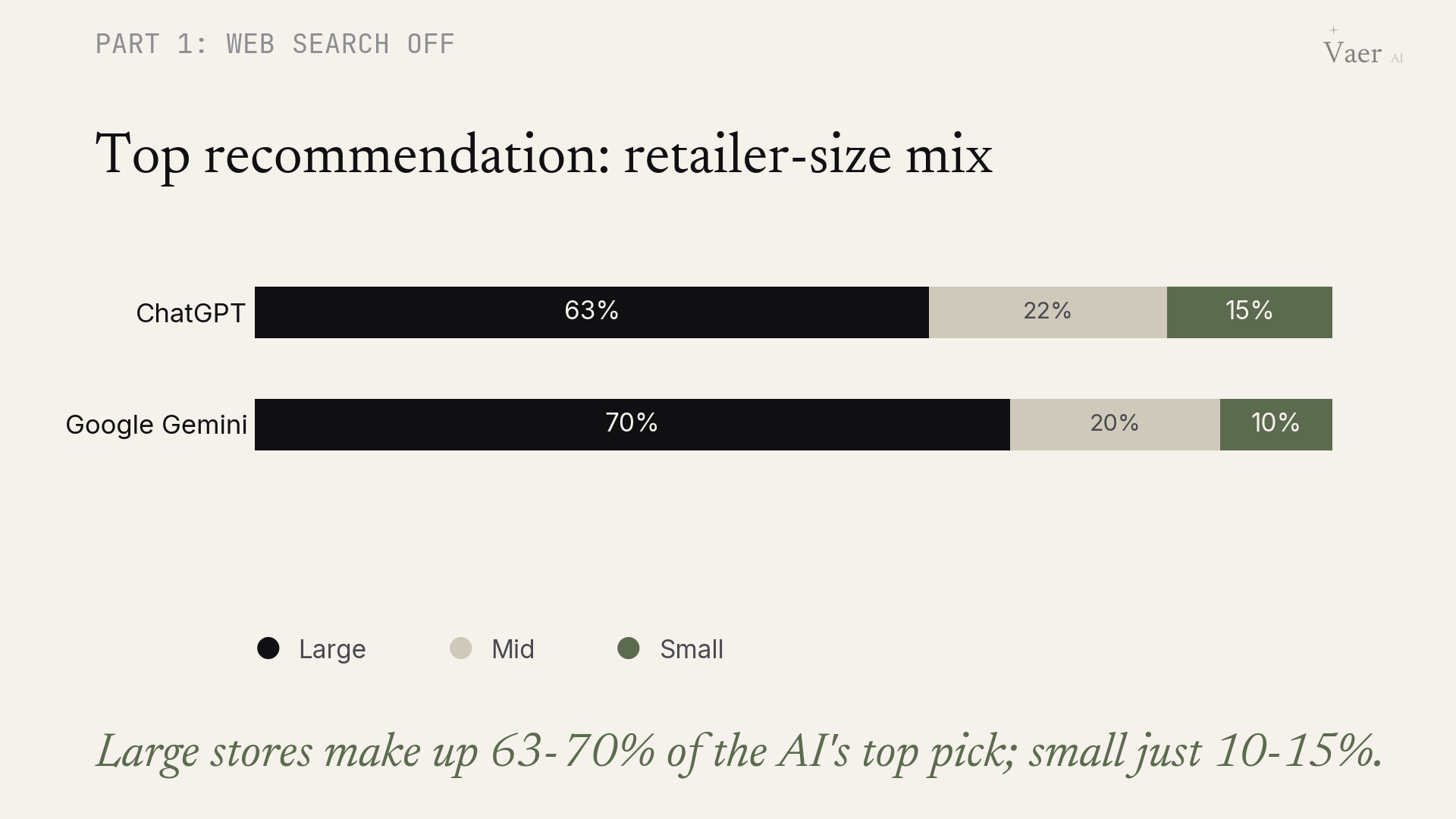
It reaches for the big names. A large national chain is its pick 63 to 70 percent of the time. A small or local independent shows up about one time in ten.
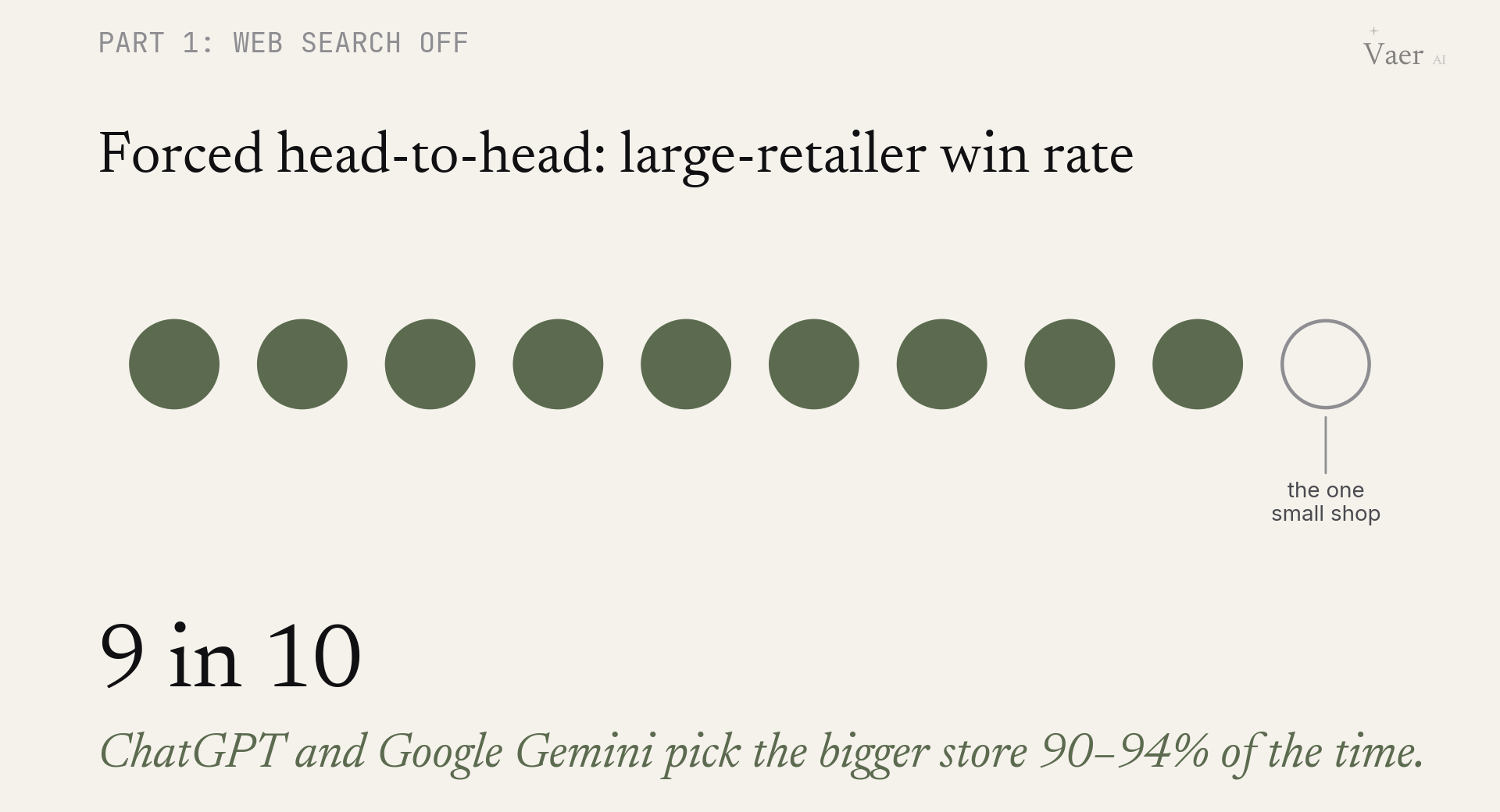
The cleanest test was a head-to-head. I showed the model one big chain and one smaller store, side by side, with nothing to say which was which, and asked it to choose. It took the bigger store 90 to 94 percent of the time. A coin flip would land at 50. When the choice is that bare, the preference stops being subtle.
A few giants do most of the work. About ten retailers, names like Home Depot, Best Buy, Target, Amazon, and Walmart, account for 40 to 44 percent of every recommendation. Not one small or local store cracks the top twelve.
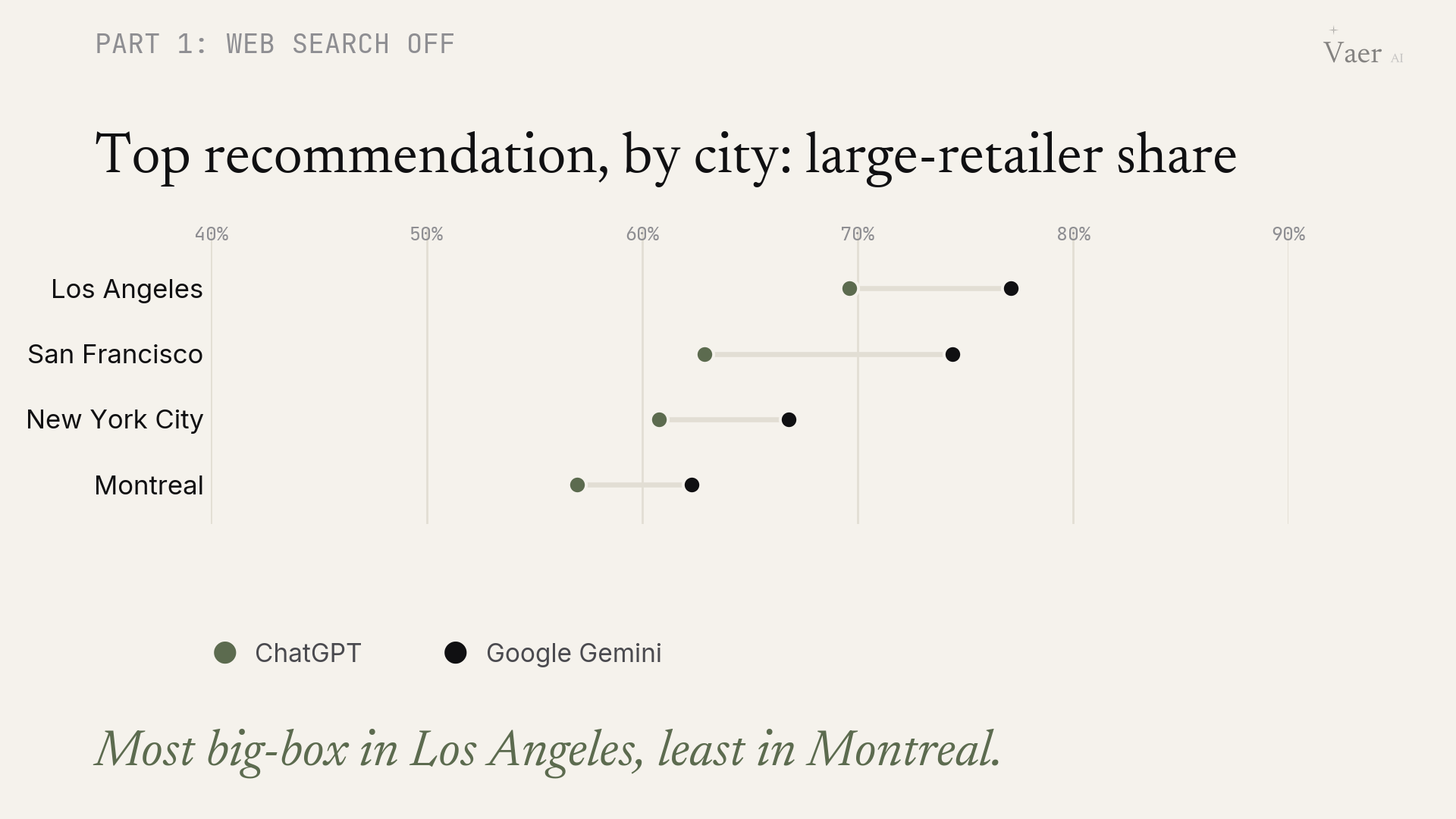
Where you live shifts the answer too. The pull toward big chains runs highest in Los Angeles, where the model names a national retailer 70 to 77 percent of the time, and lowest in Montreal, at 57 to 62. The AI carries a kind of mental map of who’s big in which town, and it brings that map to every reply.
Part 2: What actually happens with web search turned on
In normal use these AI platforms search the live web before they answer. That helps to reduce the large retailer bias, but not by much.
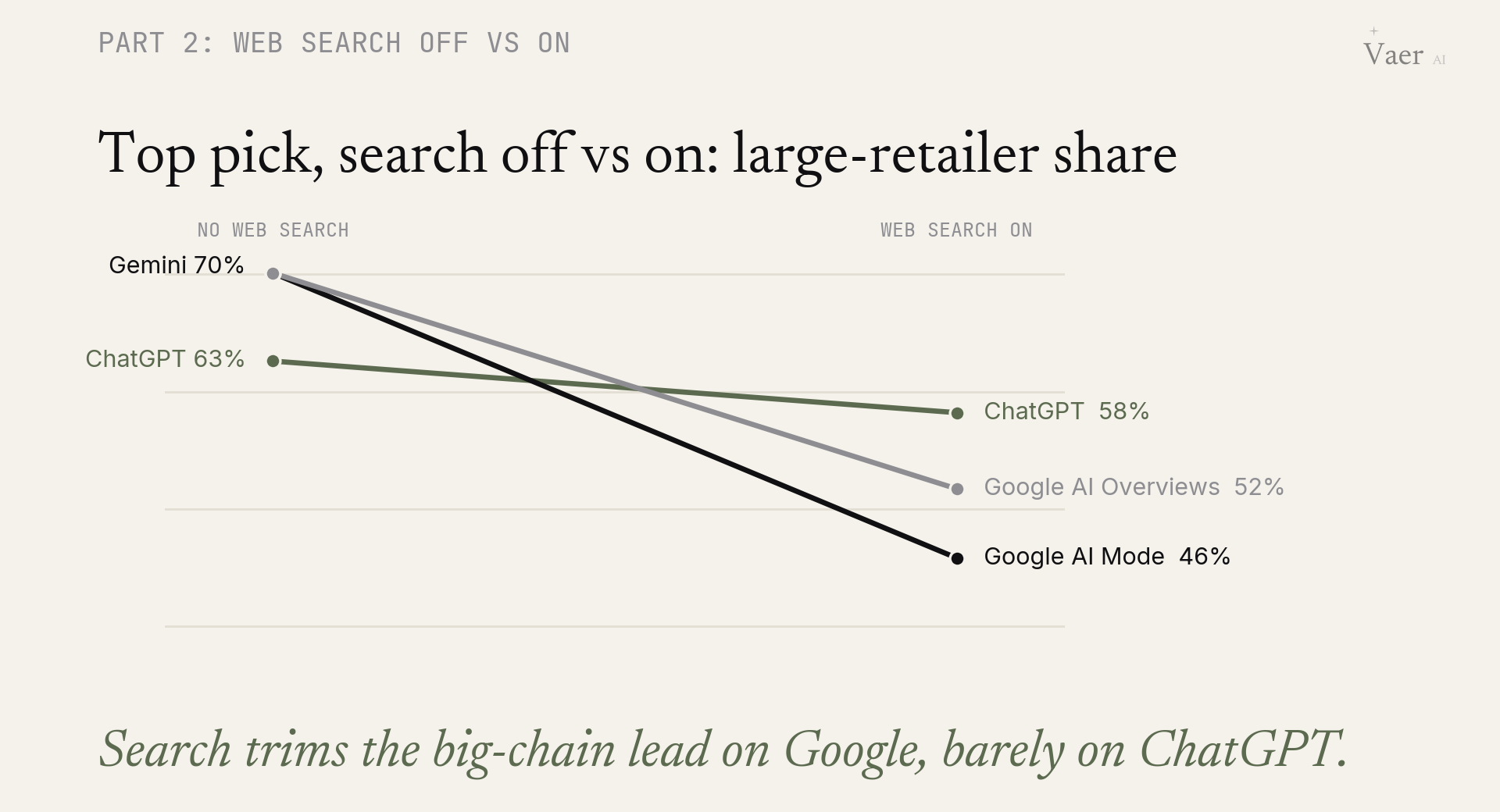
With search on, the store the AI actually names to you, the one you read, is a big national chain about half the time (46 to 58 percent) depending on the AI model, and a small or local shop about a quarter of the time. Live results do drag in more small shops than the training-data version, and the dominance of big chains drops, notably more on Google models than on ChatGPT.
Here’s why the gap exists. A web answer points you to stores in two separate places, and the two don’t match. There are the links it cites off to the side, and there are the names it writes into the sentence. Take one real ChatGPT answer to a shopper asking where to buy office supplies in New York. Three of its six cited links are small local shops. The store it names and recommends first is Staples, a national chain. The neighborhood shops make it less often into the actual answer, and when they do, they are typically not mentioned first.
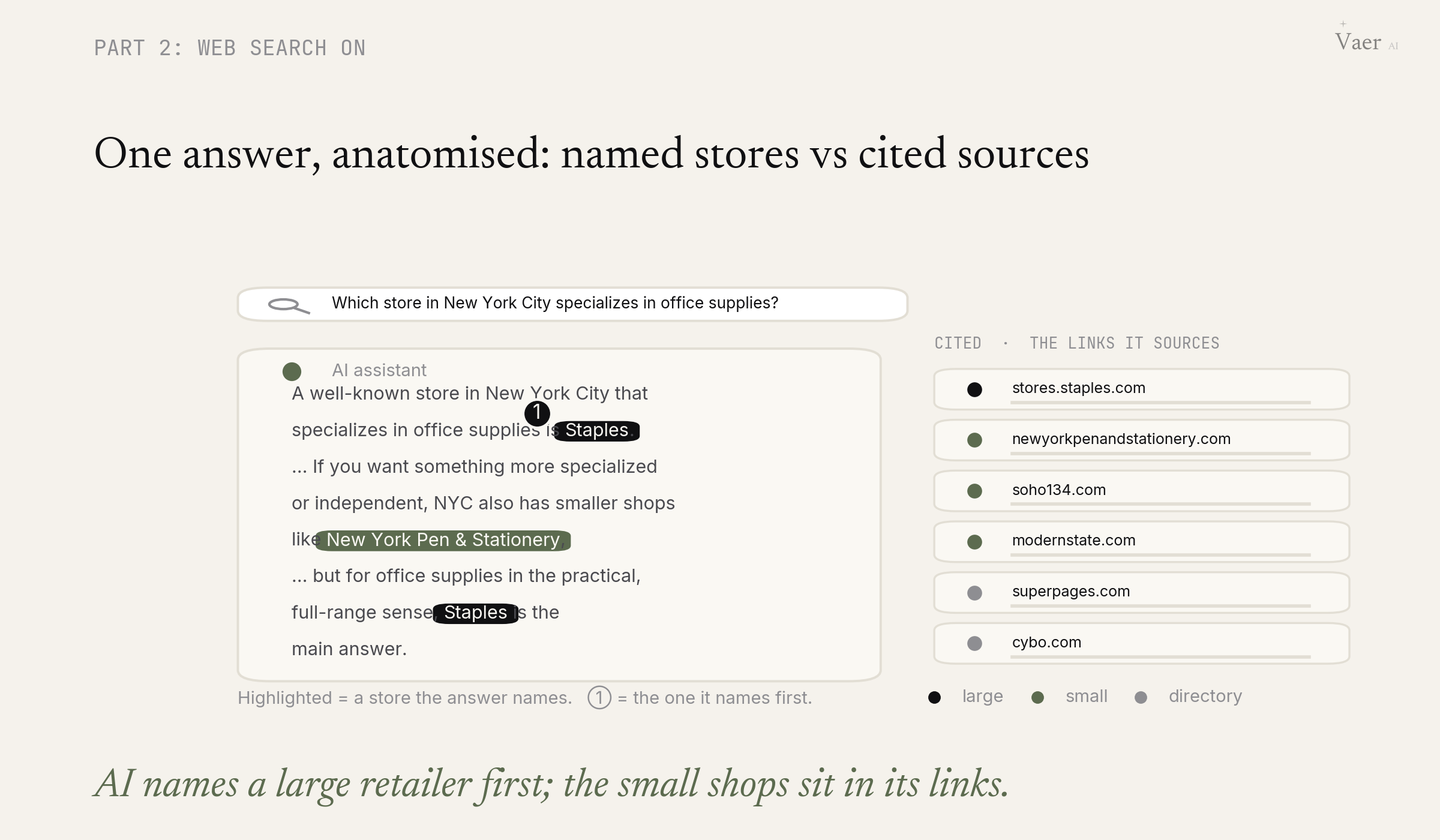
Citations ≠ Mentions
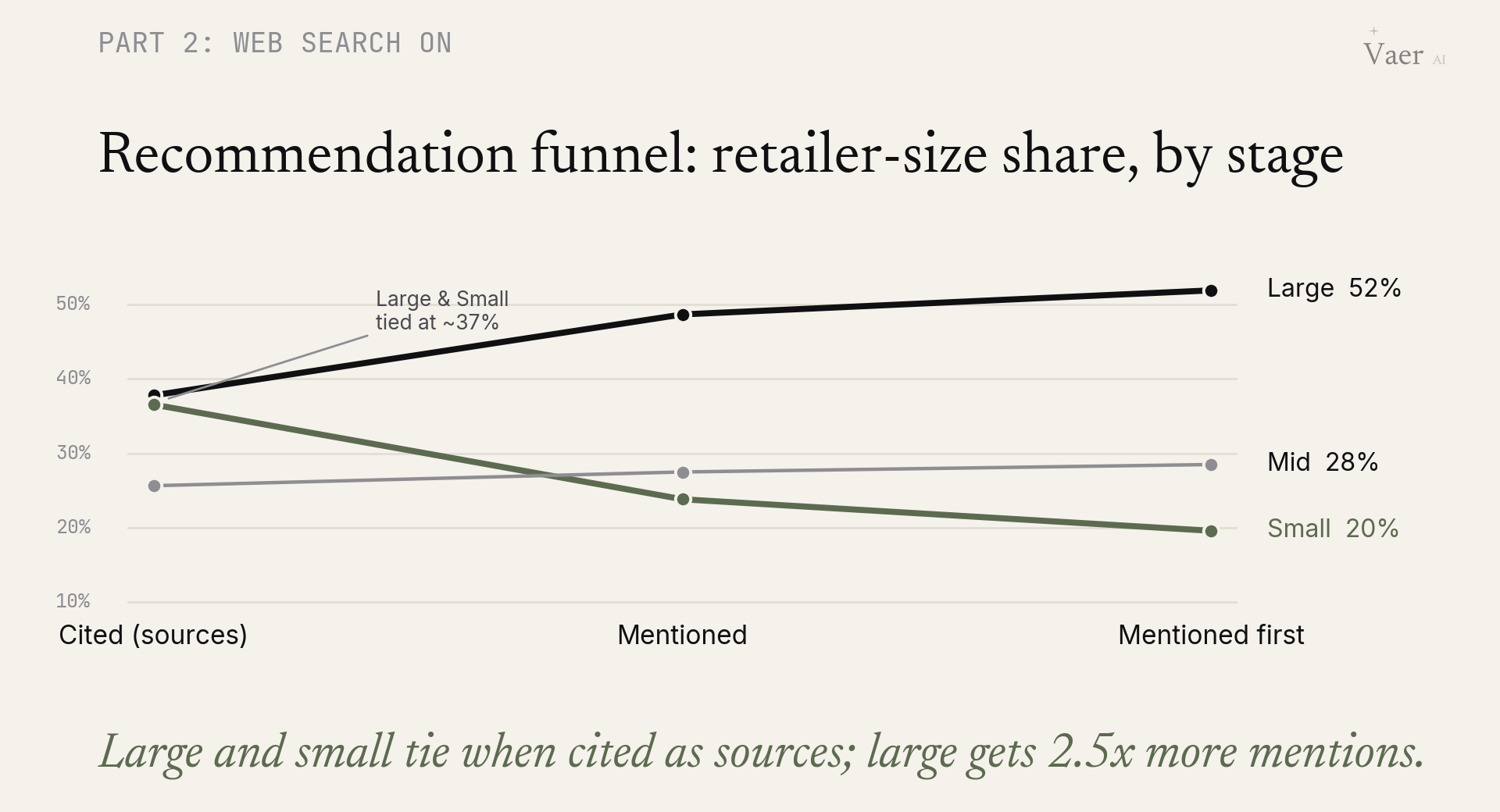
Do that across every answer and a clear shape appears. Among the stores the AI links to, big and small run about even, roughly 38 percent each. Move toward the recommendation, from what it links, to what it names, to what it names first, and the stores grow at every step while the small ones drop away. By the lead pick, a big chain wins about two and a half times as often as a small one.
Broken down by model
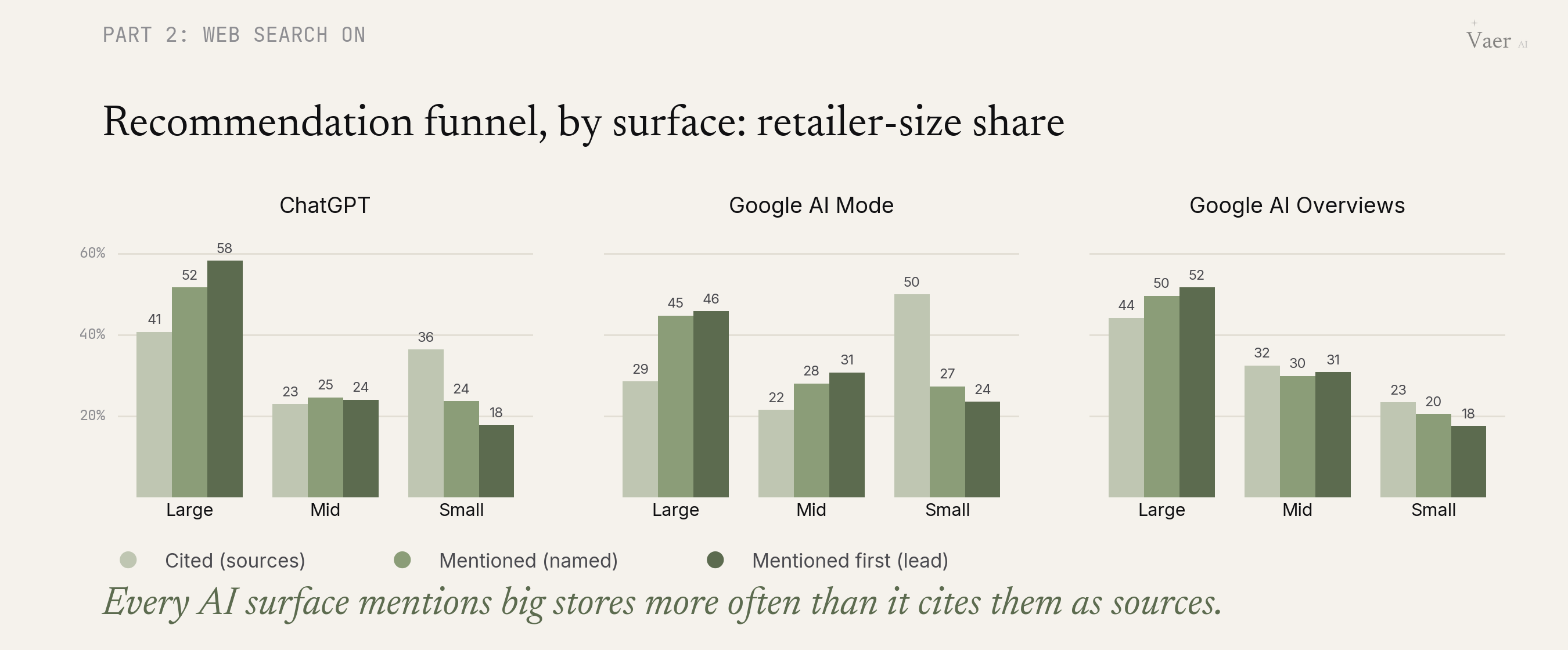
Breaking the above chart down by model allows us to reveal how each model works under the hood:
Perhaps the most surprising finding is the huge difference between how often Google AI Mode uses small retailers as a source vs. how often it picks them as its top recommendation. The underlying reason is Google AI Mode pulls in a lot of local business listings, making up around 58% of citations. However, these only convert to the top recommendation 24% of the time.
ChatGPT seems to have the strongest preference for large retailers with web search on. Even though only 41% of citations (sources) are from a large retailer, the L size brands are the top recommendation 58% of the time.
Note that even if the makeup of citations is different across the models, the share of large retailers being the top recommendation is remarkably similar, ranging from 46% to 58%.
The pattern is that large retailers are recommended even more than they are cited, and small retailers face the opposite fate. The explanation is that LLMs fall back on what they know, or to be more exact what they are confident that they know. From their training data, they are more confident about recommending larger retailers.
The closer you are to buying, the bigger the store AI recommends
One of the most interesting findings was that the more specific the product is that you search for, the top recommendation share increases for large retailers.
Again one possible explanation is that if the AI is unfamiliar with the specific product (perhaps it is new or just been released, otherwise it is just unfamiliar) it defaults to playing it safe and recommending a large retailer that it knows is likely to stock similar products.
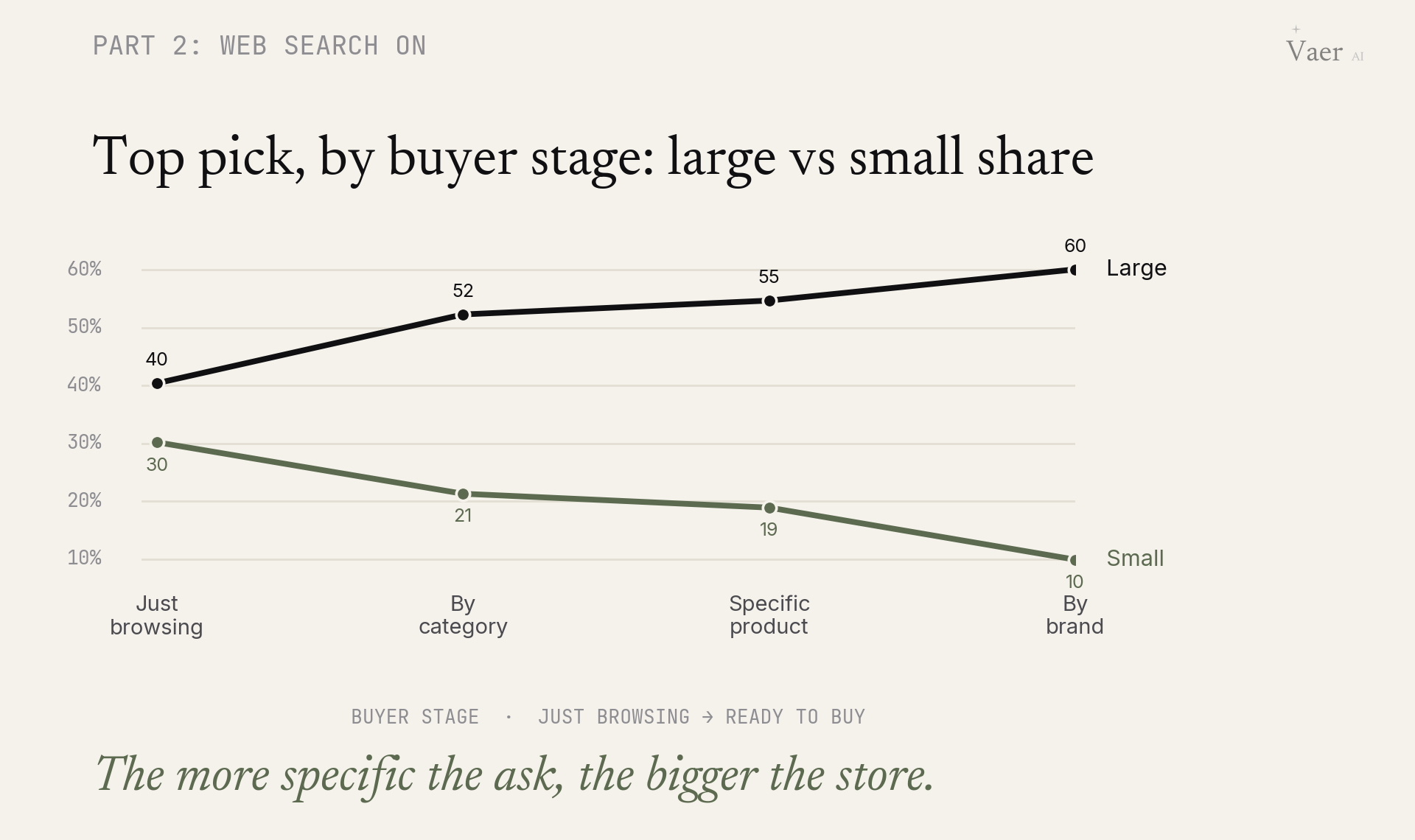
This held in both halves of the study. When you’re browsing (“toys for a six-year-old”), a small shop has a real shot, around one in three. Name something specific (“LEGO Technic Ferrari”) and that drops to about one in ten, while the big chain climbs from about 40 percent to 60 percent. Big chains reliably stock the exact item, so the AI funnels you to them right when your card is out.
It depends on what you’re buying
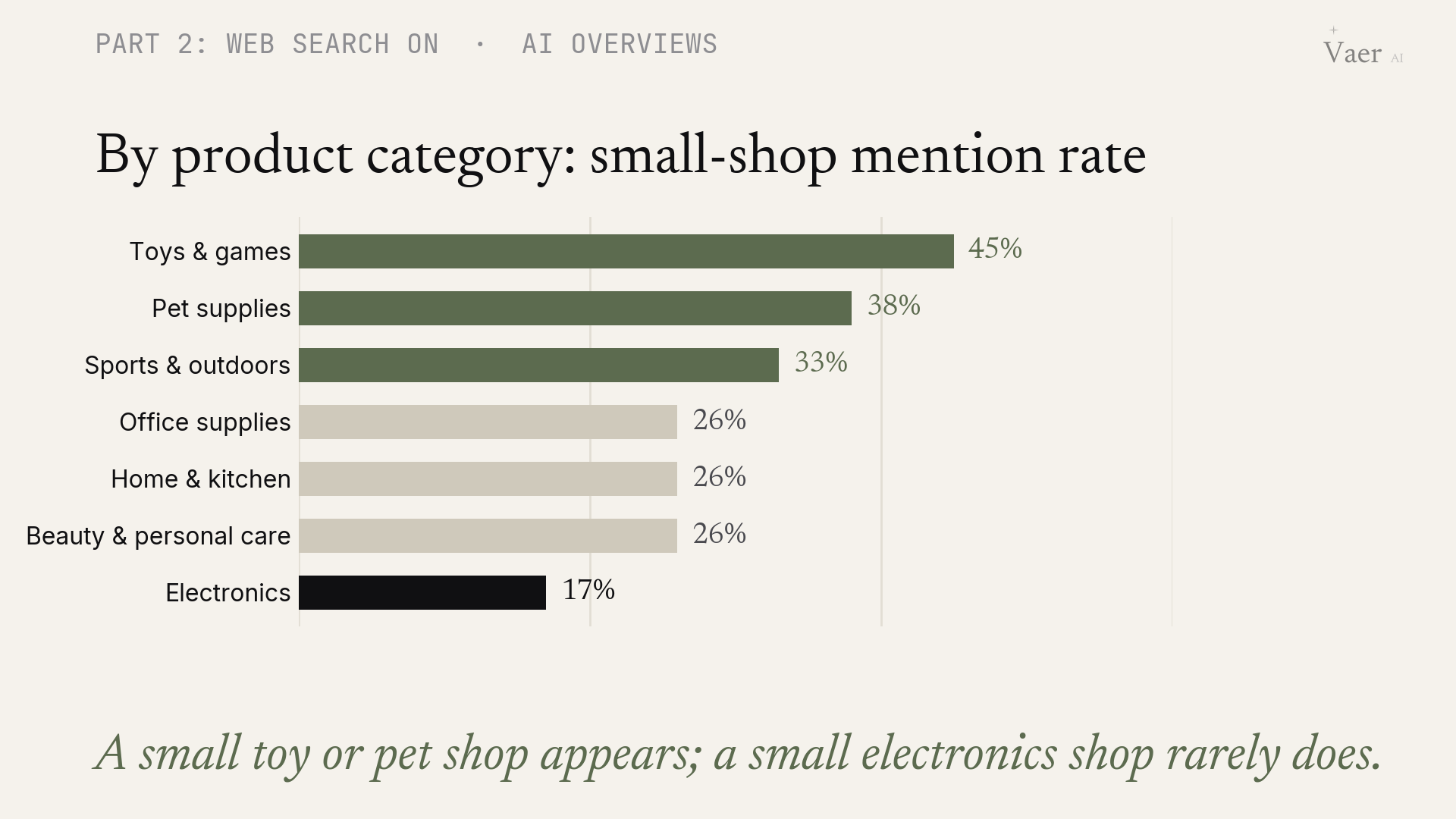
Category matters as much as anything else. Electronics is tough on small shops: a local store appears in just 17 percent of AI Overview answers. Beauty and office supplies aren’t much better. Toys and pet supplies are the soft spots, where a local shop has a real chance even on the Overview, somewhere around 38 to 45 percent. Buy a laptop and you’ll get Best Buy or Amazon. Buy a chew toy and the corner pet store might get a mention.
From Montreal to LA: the bias remains with web search on
The geographic tilt from the no-search test holds up once search is on. The answers run most big-box in Los Angeles and least in Montreal, with New York and San Francisco in between. No city escapes the big-chain plurality, but if you live somewhere the AI strongly ties to national retail, your local options get crowded out faster.
How bias enters AI systems (and never leaves)
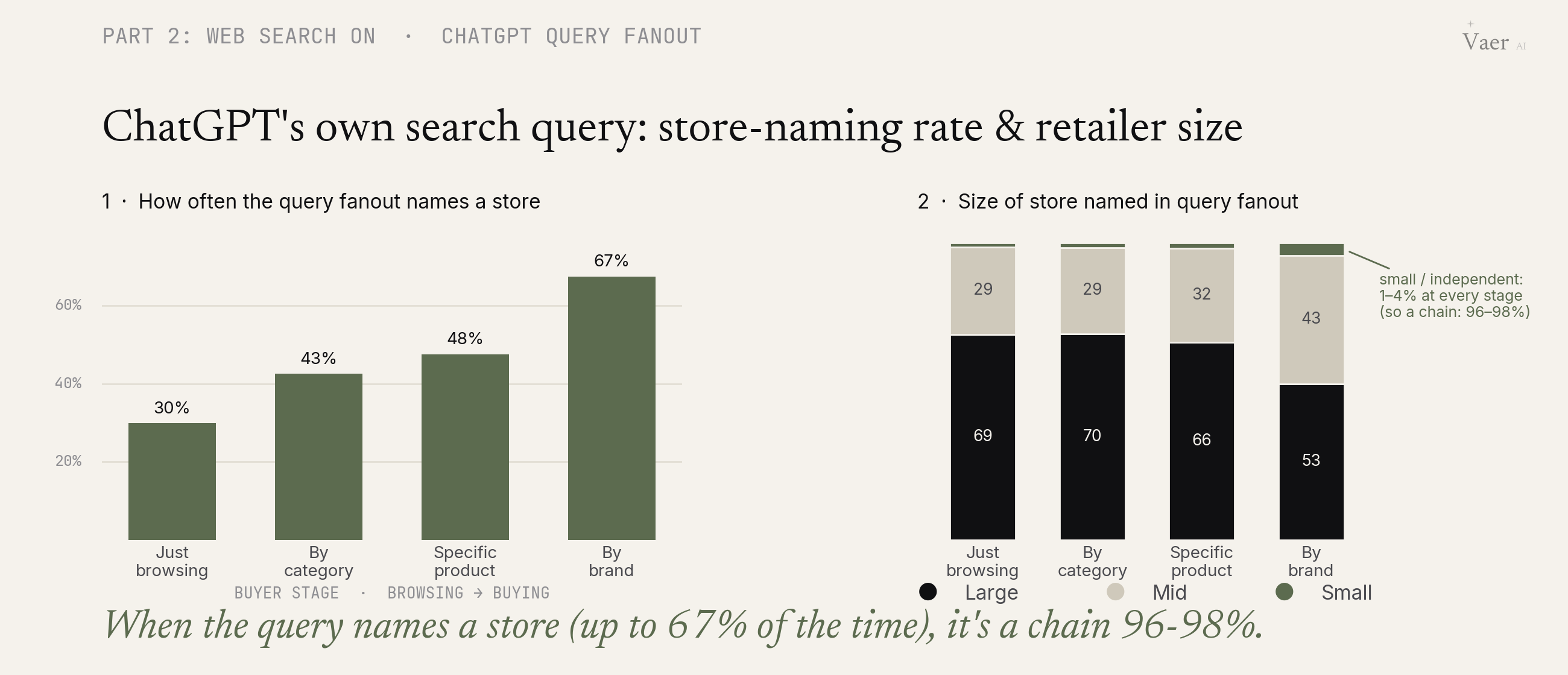
Three forces push the same way, and the first one runs deepest. The AI recommends what it already knows. With search off, it falls back on the famous chains in its training and picks the bigger store nine times out of ten. It can’t recommend the great shop down the street if it has never heard the name. That instinct even shapes what it searches for: when ChatGPT writes its own behind-the-scenes web search (a query fanout), the store it types in is a chain, large or mid-size, 97 percent of the time.
You can watch this happen in the search itself. The more specific the shopper gets, the more often ChatGPT writes an actual store name into its query, from about a third of the time for a vague request to two-thirds for a branded product. That store is almost always a chain, at every level of detail, with small and local shops stuck at one to four percent. So a good part of the bias is settled before any results come back. The model looks up the names it already knows, and the local shop is out of the running before a single link loads. Live search can only surface what the query went looking for.
Google’s own rankings are already tilted. The number one result for “where to buy X” is now 49 percent social and forum posts, the Reddit and YouTube and Yelp of the world, and only 29 percent an actual store. The AI is summarizing an internet conversation that already over-weights the brands everyone talks about.
And live search only sands down the edges, rather than notably dropping the share of big retailers. The tilt that the no-search test found in the model’s training data rides all the way through to the answer you read.
Part 3: One word can change the answer, and it isn’t the one you’d expect
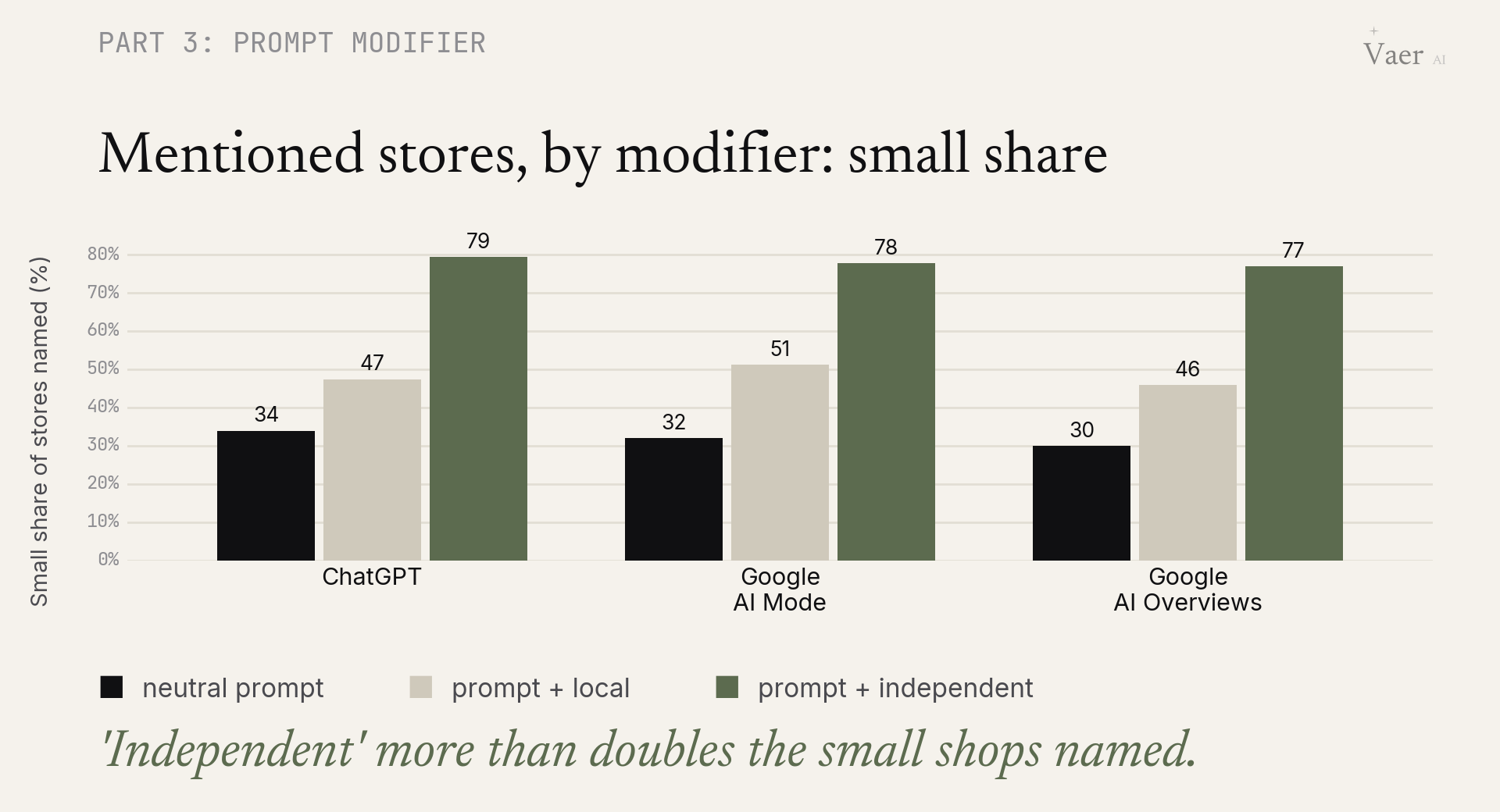
Everything above is what AI does when you ask a neutral question. So I ran one more test to see what happens when you tell it what you want. I took the same size-neutral prompts, added a single word, and ran them again through all three platforms. Same city and product, just one different word. The word was either “local” or “independent.”
Start with what you gain. Ask AI for “independent” stores and the small and local shops it names more than double, from about a third of its picks to nearly four-fifths. That holds across all three platforms. Note that the observed lift for adding “local” helped far less, because the AI platforms don’t reliably treat a local store as an independent one, i.e. a local store may also simply be geographically close.
Note: this section was run on a randomized sample of the full promptset which is why we see slightly different numbers for the share of small retailers with neutral prompts. This was done to ensure the cleanest possible comparison.
Perhaps the more revealing change is underneath the answer, in where the AI sources its information. These sources are not the stores it recommends to you (mentions). They are the webpages it reads before it writes a word. With a plain prompt, about 44 percent of the retailer sources it pulls are big national chains. Add “independent” and that share falls to as low as 9 percent, with the largest effect seen on the Google platforms. The AI treats “independent” as a genuinely different request from “where can I buy this,” and reads a different slice of the web to answer it.
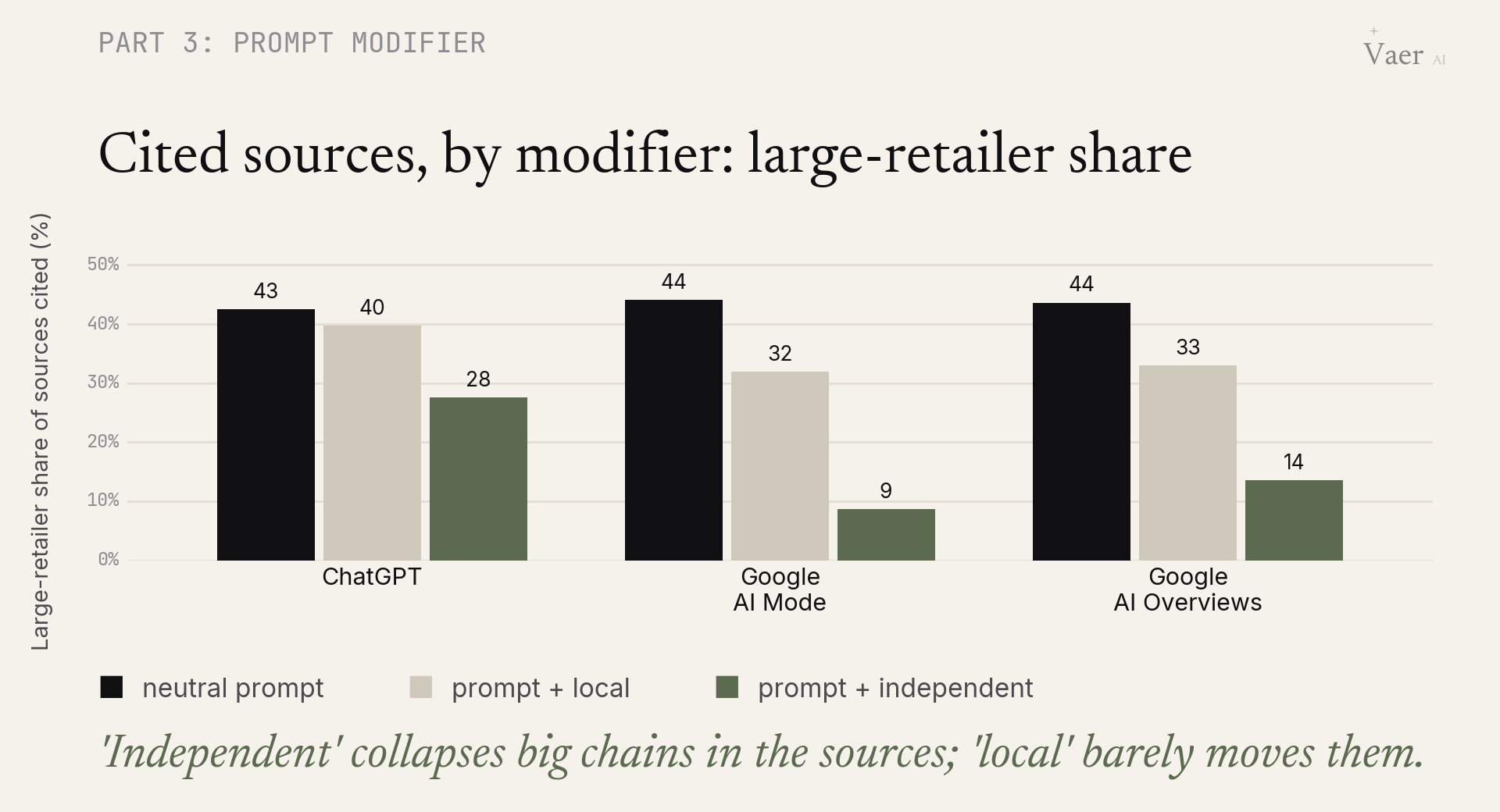
“Local” barely does any of this. On ChatGPT it changed almost nothing. On the two Google platforms it helped a little, nowhere near as far as “independent” did. The reason is that “local” is easy for the AI to shrug off. It will count your local Best Buy or the nearest chain branch as a local store, so the sources come back looking much the same, and so does the answer. “Independent” is harder to fake, because a national chain can’t honestly claim it.
Here is the part worth remembering. The words most people would reach for are the weak ones. “Near me” and “local” are the natural things to type, and they do almost nothing. The word that actually works is the one you probably would not think to use.
What you can do
A few habits help to beat the bias:
- Ask for “independent,” not “local.” This one word does most of the work. Try “independent stores in [your city] that sell X.” Asking for “local” or typing “near me” barely changes the result, because the AI counts a nearby chain as local.
- Browse before you commit. General questions return more local options than product-specific ones.
- Scroll past the AI Overview. It’s the most big-box-skewed thing on the page. Google’s Local and Maps results are far richer in small businesses.
- Ask for a second opinion. For local shops, AI Mode and ChatGPT both beat the Overview box. If one only shows you chains, try another.
A store missing from the answer doesn’t mean it’s the wrong choice. Often it just means the AI never learned the name.
Key stats and takeaways
- When forced to use its training data, the AI names a national chain about two-thirds of the time and a small or local shop only one in ten. Put a big chain and a smaller store side by side with no labels, and it picks the big one 90 to 94 percent of the time.
- Turning on live web search helps, but only by about a third. When the AI names a store, it’s still a national chain about half the time and a local shop about a quarter.
- Google’s AI Overview is the worst, and the one most people see. Two out of three of its shopping answers name no small or local store at all.
- The closer you get to buying, the bigger the store. Name a specific product and a small shop’s odds of being the top pick fall from about one in three to one in ten.
- The local shops do show up in the AI’s source links, just not in what it actually recommends. The deeper you go, from the links it cites, to the stores it names, to the one it names first, the more the small shops drop away.
- A short list of giants does most of the work. About ten chains account for 40 to 44 percent of every recommendation, and no small or local store makes the top twelve. Where you live tilts it too: heaviest toward big chains in Los Angeles, lightest in Montreal.
A note on the numbers
This study is based on just under half a million AI answers, 200,000 with web search off and 260,000 with it on, to 20,000 questions (prompts), repeated across several runs and two AI companies (ChatGPT and Google Gemini). The prompts were written to be size-neutral in parts 1 and 2. Every store’s size was classified into three bands: L (1 billion+ revenue), M ($50M to $1B) and S (under $50M).
This study was conducted by Tom Wells, co-founder and principal consultant of Vaer AI, on behalf of Lightspeed Commerce. The full technical report and methodology are available on request.